Between the Sound of the Sea and the Silence of a Gallery.
How Nature, Art and Sensory Design Shape the Way We Feel.
Everything we need to know about plusses that is giving us a simple holidays walk on the beach and what cost nothing and bring us to the another level of our perception of every day.

*multi-sensory experience delivered through interior design and architecture projects by Livetouch.design
IN THIS GUIDE
How Nature, Art and Sensory Design Shape the Way We Feel.
Why the Sound of the Sea Calms the Mind.
Between the Sound of the Sea and the Silence of a Gallery.
The Architecture of Silence.
Five Senses, One Experience.
Designing Homes That Feel Better.
The New Definition of Luxury.
During the summer months, many of us instinctively seek the sea. We travel to coastlines, walk barefoot on the sand, pause to watch the horizon and, often without realizing it, allow ourselves to slow down. The rhythm of the waves, the salty breeze and the vast openness of the landscape offer something increasingly rare in contemporary life: mental space.
Why the Sound of the Sea Calms the Mind
The sound of the sea is one of the best researched natural acoustic environments in relation to human wellbeing. Within neuroarchitecture and multisensory design, it represents a perfect example of how carefully balanced sound can positively influence our nervous system.
The gentle rhythm of breaking waves closely resembles what scientists describe as pink noise. Unlike white noise, which distributes energy equally across all frequencies, pink noise gradually decreases in intensity at higher frequencies, creating a softer, warmer and more natural acoustic pattern. Many sounds found in nature including rainfall, rustling leaves and ocean waves share these characteristics.
For the brain, this predictable rhythm creates a sense of safety.
Without abrupt changes or unexpected interruptions, the nervous system no longer needs to remain in a constant state of alertness. Instead, breathing slows naturally, muscle tension decreases and attention shifts away from stress towards quiet awareness.
Research has shown that natural soundscapes such as ocean waves can:
reduce activation of the body's stress response,
lower cortisol levels,
slow heart rate,
improve mood,
mask disruptive environmental noise,
support concentration,
and encourage deeper, more restorative sleep.
The sea never asks anything from us.
It simply continues its rhythm.
Perhaps that is precisely why our bodies remember how to relax in its presence.
Between the Sound of the Sea and the Silence of a Gallery
There are places that remain with us long after we leave them.
Not because they were spectacular, but because something inside us became quieter.
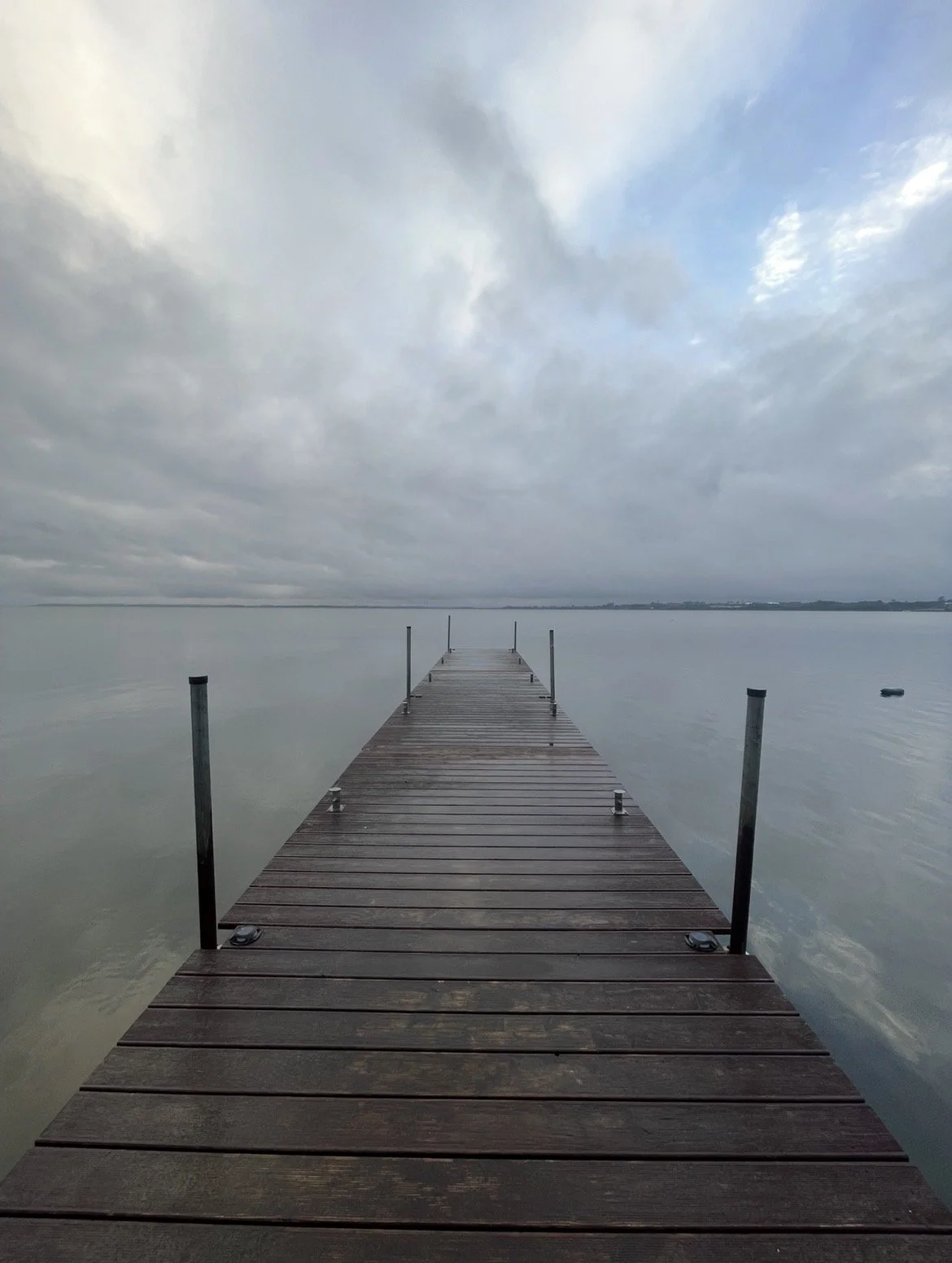
An early morning beside the sea. Gentle waves meeting the shore beneath soft morning light. Or perhaps a contemporary gallery where daylight slowly moves across the surface of a painting and every footstep is softened by silence.
One environment is created by nature.
The other by human imagination.
Yet both offer the same rare luxury: the opportunity to become completely present.
In today's world, the greatest luxury is no longer time.
It is attention.
The Architecture of Silence
The sea never tries to impress us.
It simply exists.
Always changing, yet deeply predictable.
Every wave resembles the one before it, but none are ever identical.
This natural rhythm becomes a metronome for our nervous system.
A thoughtfully curated gallery creates a remarkably similar experience.
Not through abundance, but through restraint.
White walls are not an absence of decoration; they create space for reflection.
Silence is not emptiness.
It is an invitation to notice.
Only then do we begin to observe subtle details: the movement of daylight across a canvas, the grain of oak, the texture of limestone, the hand of the maker preserved in clay or the delicate shadow cast by a sculpture.
Great works of art never demand immediate attention.
They patiently wait until we are ready.
Five Senses, One Experience
At LiveTouch, we believe architecture is never experienced through vision alone.
The sound of the sea becomes a rhythm.
The scent of salt becomes a memory.
The coolness of natural stone beneath our feet, warm timber touched by sunlight or fine sand slipping through our fingers become experiences that cannot be fully captured in photographs.
Art works in exactly the same way.
A painting communicates not only through colour but through texture.
Ceramics invite touch.
Handwoven textiles carry the memory of the hands that created them.
A sculpture changes as we move around it, while daylight quietly becomes its collaborator.
The most meaningful interiors are therefore not collections of beautiful furniture or carefully selected finishes.
They are choreographies of sensory experiences.
Every material, every sound, every reflection of light contributes to how we feel inside a space.
Art as a Form of Everyday Wellbeing
For decades, art has often been treated as decoration a final element added once the interior is complete.
Yet its true value has very little to do with investment or prestige.
Its greatest power lies in its ability to gently interrupt the pace of everyday life.
A painting viewed during morning coffee.
A ceramic vessel shaped by hand.
A sculpture that catches changing daylight.
A photograph recalling a meaningful journey.
Or even a smooth stone collected during a walk along the coast.
These objects become emotional anchors.
They reconnect us with memories, places and moments that matter.
Scientific research increasingly suggests that exposure to meaningful art can reduce mental fatigue, encourage emotional reflection and stimulate areas of the brain associated with empathy, curiosity and creativity.
In this sense, art functions much like nature.
It restores rather than overwhelms.
Designing Homes That Feel Better
The most beautiful homes rarely resemble catalogues.
They resemble personal journals.
Every artwork tells a story.
Every object preserves a memory.
Every material ages alongside the people who live with it.
Rather than filling a room quickly, allow it to evolve gradually.
Collect experiences before collecting objects.
Choose fewer pieces, but choose them intentionally.
This is why galleries continue to inspire interior designers.
They never reveal everything at once.
They guide us through rhythm, proportion, light and carefully designed moments of pause.
Our homes can do exactly the same.
When selecting art, begin not by asking which piece matches your sofa, but by asking:
Which artwork would I love to wake up with every morning?
Allow the artworks room to breathe.
The empty space surrounding them is often just as important as the work itself.
Design with natural light, because it transforms every artwork throughout the day.
Pair art with materials that mature beautifully solid timber, natural stone, linen, wool, bronze and hand-shaped clay.
Celebrate craftsmanship.
The subtle imperfections of handmade objects remind us of the human touch behind their creation.
And remember:
Art does not always hang on a wall.
Sometimes it is sunlight entering through a tall window.
The shadow of a tree moving across limestone.
The scent of cedar.
The texture of linen beneath our fingertips.
Or simply...
Silence.
The New Definition of Luxury
Luxury was once associated with abundance, rarity and excess.
Today, its meaning is quietly evolving.
The greatest luxury is the ability to truly feel.
Silence instead of noise.
Natural light instead of visual overload.
Authentic materials instead of passing trends.
Spaces that care for our attention rather than compete for it.
The sea reminds us that harmony is born from nature's rhythms.
Art galleries remind us that beauty requires space, light and stillness.
Our homes and equally our workplaces, hospitality environments, healthcare settings and cultural institutions can become places where these two worlds meet.
Through neuroarchitecture, sensory design and carefully curated art, we can create interiors that do more than look beautiful.
They support health.
They encourage presence.
They restore emotional balance.
At LiveTouch, this philosophy guides every project we undertake, from private residences to public environments. We believe that thoughtfully designed spaces have the power to improve everyday life
not only through form and function, but through the subtle dialogue between architecture, art and the human senses.
Because the most successful interiors are not designed simply to impress in photographs.
They are designed to evolve with the people who inhabit them.
To help us see more carefully.
To breathe more deeply.
To feel more consciously.
Perhaps this is the highest expression of luxury:
A space that quietly nurtures wellbeing through every sense.